
This is Information Sheet 225 (INFO 225). It is directed to businesses and people offering products and services in relation to digital assets generally. It will help you to understand your obligations under the Corporations Act 2001 (Corporations Act) and the Australian Securities and Investments Commission Act 2001 (ASIC Act) if:
- your business is involved with digital assets – for example, crypto-assets, crypto tokens, utility tokens, asset-referenced tokens, stablecoins, or tokenised assets (including where the underlying assets may be financial products or other assets), whether there are elements that are decentralised or not (e.g. exchanges, intermediaries, digital asset wallet providers, operators of decentralised finance platforms, asset managers and custodians)
- you are, or are considering, issuing or selling digital assets, dealing in (including establishing a platform to trade or facilitate payments) or advising on digital assets or whether to raise funds or otherwise, or offering other products or services related to digital assets.
Consumers should read information and warnings about crypto-assets on our Moneysmart website. Consumers are only protected by the financial services laws ASIC administers to the extent that any digital assets and related services are subject to those laws. If you invest in something that is unlicensed or unregulated in Australia, it is harder to get help if things go wrong.
Overview
This information sheet is not, and is not intended to be, an exhaustive discussion of:
- all the relevant Australian laws, regulations, ASIC guidance or ASIC relief about financial products and services
- how digital assets and any related products, however structured, fit into the existing financial services regime, or
- your legal and regulatory obligations.
It is your responsibility to ensure you understand and comply with all relevant and applicable Australian laws and regulatory requirements.
Note: The scope of what is and is not a financial product differs slightly between the Corporations Act and the ASIC Act.
For a discussion of distributed ledger technology, see Information Sheet 219 Evaluating distributed ledger technology (INFO 219).
The use of offshore or decentralised structures does not mean that key obligations under Australian laws do not apply or can be ignored: see Regulatory Guide 121 Doing financial services business in Australia (RG 121). Australian laws apply where the digital asset is promoted or sold, or services are provided in relation to them, in Australia, including from offshore. We encourage entities to build their products and services in a way that complies with the intention of the laws in place to safeguard consumers and the integrity of financial markets in Australia.
Note: This information sheet does not comment on when someone in a ‘decentralised finance’ (or DeFi) arrangement may require a licence, or what might be considered ‘true DeFi’. Whether a person needs a licence in these circumstances is dependent on the individual facts of each DeFi arrangement and the person’s role and offering in the arrangement and/or ongoing participation.
Other supporting documents, legislation and examples
Links to other supporting documents are included throughout this information sheet. Guidance provided here should be read together with that broader material.
The 18 hypothetical worked examples in Part A of this information sheet are not exhaustive. They are designed to help you think about these issues, but each product needs to be assessed on its own facts and circumstances. The examples provided indicate whether the digital asset or related product is likely – or unlikely – to be a financial product and, if so, which type of financial product.
The Corporations Act references through this information sheet are relevant for determining the licence authorisations and regulatory obligations that may apply to your digital asset offerings. Also, as changes in rights and benefits over time may change the legal status and financial products classification of a digital asset, it is your responsibility to reassess a digital asset as rights and benefits change.
This information sheet is based on current law. As at the date of this update, the Australian Government is consulting on an exposure draft for amendments to introduce digital asset platforms and tokenised custody platforms as new financial products (see Regulating digital asset platforms – exposure draft legislation on the Treasury website), as well as for payment service providers, which includes proposals to regulate certain stablecoins (see Regulation of Payment Service Providers – Tranche 1a draft legislation on the Treasury consultation hub). This information sheet may be updated in due course to reflect these developments when they are finalised, and relevant case law developments.
INFO 225 also refers to the Australian Consumer Law. However, it does not cover Australian legislation administered by other regulators who oversee digital assets and digital asset service providers, such as the Australian Transaction Reports and Analysis Centre (AUSTRAC), the Australian Prudential Regulation Authority (APRA), the Australian Taxation Office (ATO), the Australian Competition and Consumer Commission (ACCC), and the Reserve Bank of Australia (RBA).
This information sheet now uses the term ‘digital assets’ (it previously referred to ‘crypto-assets’). However, it is intended to apply to a wide range of digital and crypto-assets, whether described as digital assets, crypto-assets, virtual assets, tokenised assets, tokens or coins. Accordingly, the term ‘digital assets’ is used in a general context and its use is not intended to exclude any particular product.

Part A: Digital assets that are, or are a part of, a financial product
Background
Entities and their advisers need to consider all the rights and benefits attached to the digital asset, as well as the rights and benefits attached to the arrangements provided in connection with the digital asset. This includes the way in which the products will be offered to, and used by, the consumer in practice. This analysis is critical to determining whether the digital asset, and/or arrangement related to the digital asset, is a financial product.
Our experience suggests that people often seek to raise money from the public or privately to fund a particular project (e.g. an enterprise) by issuing digital assets. If the digital asset, or a related product, is a financial product, the issuer will need to comply with the relevant provisions of the Corporations Act, such as Australian financial services (AFS) licensing requirements and/or other regulatory requirements, subject to any relevant exemptions. These regulatory requirements are in place to maintain the integrity of Australia’s financial markets and to protect consumers and investors.
If you are operating without a licence or without being an authorised representative of a licensee, you should be prepared to substantiate and justify why the digital asset(s) or related products or arrangements are not a regulated financial product (and why you are not undertaking a financial service or operating a market or clearing and settlement (CS) facility that requires a licence – see Part B and Part D). You should be able to justify this in relation to all aspects of your offering. For example, a project may in some circumstances feature multiple types of digital assets and involve one or more arrangements which may need to be assessed individually and then in combination.
This section considers types of digital assets made available to consumers in Australia and whether the Corporations Act might apply to them as various types of financial products. It addresses the following question – when could a digital asset, or product involving digital assets, be:
- a facility for making a financial investment?
- an interest in a managed investment scheme? (‘scheme’)?
- a security (e.g. a share or a debenture)?
- a derivative?
- a non-cash payment facility?
This is not an exhaustive list of financial products to consider.
Any given digital asset or related product could potentially meet more than one financial product definition in the Corporations Act (e.g. a digital asset could potentially meet the definitions of both a debenture and a non-cash payment facility). In those cases, the priority of classification of financial products set out in the Corporations Act applies: see section 762A.
Aggregated arrangements
Even if a digital asset, when considered by itself, is not a financial product, if it is bundled together with one or more other products or services, and it is reasonable to assume that the parties to the arrangement regard them as a single arrangement, the arrangement may be a financial product: see section 761B of the Corporations Act. This would also mean that a person giving advice on or dealing in that aggregated arrangement would be providing a financial service: see Part B.
When a broader facility is made up of multiple components, of which one component is a financial product, the Corporations Act will apply to the component that is a financial product: see section 762B of the Corporations Act.
Incidental products and broader facilities
If a digital asset, or an arrangement involving a digital asset:
- forms an incidental part of a broader facility, or is an incidental facility to one or more other facilities, and
- it is reasonable to assume that the broader facility or those combined facilities do not have the main purpose of making a financial investment, managing financial risk or making non-cash payments,
it will be treated as incidental: see section 763E of the Corporations Act.
A product that is treated as incidental is not a financial product, unless specifically included under section 764A of the Corporations Act.
Rights and benefits attached to digital tokens and assets
The rights and benefits attached to digital assets, or products involving digital assets, are a key consideration in assessing the legal status of those digital assets and products. These rights and benefits can be described in terms and conditions, or a ‘white paper’, or other documents issued by the business making the offer or sale of the digital asset. Rights and benefits may also be determined from other circumstances (e.g. by how the digital asset is marketed to potential clients, advertising materials, communications with clients and other documentation which sets out legal rights and benefits attached to a digital asset and its related arrangements).
What is a ‘right’ should be interpreted broadly. Rights that may arise in the future or on a contingency, and rights that are not legally enforceable, are included.
The rights and benefits may change over time with changes in the features or uses of the digital asset and how common use of the digital asset evolves: see Digital assets that are, or involve, a facility for making a financial investment.
For convenience, in some places this information sheet refers to whether particular digital asset ‘tokens’ are likely to be a financial product. This is a short-hand expression – what we are in fact referring to is the bundle of rights, benefits, expectations and product features that are associated with a particular token as offered to the public.
Some of the rights and benefits from holding the tokens are enforceable, others are more in the nature of a statement about the intentions of the offeror, and others are more a consequence of the code used in the smart contracts associated with the digital asset. When we refer to the legal status of a ‘token’ it should generally be understood as a reference to the legal status of the overall arrangement that includes the token as offered to the public.
This means that a ‘token’ is not separated from its associated bundle of rights, benefits, expectations and features for the purpose of being traded on a digital asset or crypto platform. Generally, we understand that when someone trades a ‘token’ they are transferring the rights associated with that token, in the same way as trading shares or giving a gift card transfers the rights associated with those products.
With a product or service involving a digital asset, sometimes there is uncertainty about what part of the arrangement is the financial product. While this is an evolving area, some analogies can be drawn from the case law and the treatment of traditional products. For example:
- for a managed investment scheme (e.g. an exchange traded fund (ETF)) – the individual unit is the financial product, and
- for a company limited by shares – the individual share is the financial product.
Digital assets that are, or involve, a facility for making a financial investment
This section discusses when digital assets are, or involve, a facility for making a financial investment. We provide five examples that explore how the definition applies to digital assets and related products.
What is a facility for making a financial investment?
A facility through which, or through the acquisition of which, a person makes a financial investment is a financial product under the Corporations Act (section 763A and 763B). The key elements are that:
- the client gives money or money’s worth to another person and any (or all) of the following apply:
- the other person uses the contribution to generate a financial return, or other benefit, for the client
- the client intends that the other person will use the contribution to generate a financial return, or other benefit, for the client (even if no return or benefit is in fact generated)
- the other person intends that the contribution will be used to generate a financial return, or other benefit, for the client (even if no return or benefit is in fact generated), and
- the client has no day-to-day control over the use of the contribution to generate the return or benefit.
To expand on parts of the key elements of this definition, ASIC’s notes:
- ‘Money’s worth’ is a broad concept that includes a wide range of potential types of contributions.
- The ability to withdraw from a facility or vote on matters is not sufficient for a person to be considered as having day-to-day control of the use of the funds.
- It looks at how the facility is ‘commonly’ used by people that acquire the product, even if a specific person acquired the product for some other purpose.
- A facility does not cease to be a financial product merely because it was acquired by a person other than the person to whom the product was originally issued, and that person who acquired the product is not making a financial investment.
- The purchase of an asset by a person to generate a return does not necessarily mean the asset is a financial product, if the returns are not generated by the use of the purchase money: see note 2(a) to section 763B.
- If a person gives money to a second person (e.g. an intermediary) for the purchase of a financial product for the first person, the mere act of giving the money to the second person will not of itself mean that the second person is offering a facility for making a financial investment (even if the purchase of the financial product will be a financial investment made by the first person: see note 2(b) to section 763B.
Note: The second person may be providing a financial service, such as dealing or making a market in the financial product.
- The financial return or benefit does not necessarily have to be in the form of a dividend, cash distribution or interest payment. Returns may be retained within the enterprise (e.g. as retained earnings) and the benefits may be transmitted to clients by way of a capital gain instead (e.g. an increase in the price or value of the investment instrument).
Application to digital assets
Often the price or value of a digital asset is directly or indirectly linked to the success of a business or project (an enterprise). This is particularly the case where digital assets are expressly issued as a way to raise funds for a particular enterprise, with the funds to be used in that enterprise.
Some digital asset projects involve a buy-back or other benefits so that the holders may receive a return if the enterprise is a success. Others involve a right to receive discounts or other promotions linked to the enterprise. Other initiatives give an expectation of capital gains from the increase in the value of the digital asset if the enterprise or project funded by the digital asset is successful.
Products without an identifiable issuer
Some digital assets do not have an identifiable issuer, nor any promises or representations that digital assets can be used for a financial product purpose (e.g. as an investment or for making payments).
The presence or absence of an identifiable issuer does not necessarily determine whether or not the digital asset is a financial product.
Whether a digital asset has an identifiable issuer is sometimes a matter of degree. Some have a founder who is still involved in the underlying project to which the digital asset is connected, others have an umbrella organisation or foundation that coordinates work on the underlying project, updates to the associated code and so on who, depending on the circumstances, could be considered an issuer. Other times, it may be that the person who interacts with the digital asset arrangement could be considered the issuer.
Example 5: Bitcoin
Scenario
Bitcoin is generally considered the earliest crypto asset. It was originally created by a person or persons unknown, and described in the 2008 white paper, Bitcoin: A Peer-to-Peer Electronic Cash System (PDF 180 KB). While there are a range of players involved in the continued maintenance and development of the Bitcoin network, there is no person (or group of closely associated persons) who control the project and network in practice.
Bitcoin’s value is volatile and is set by the market, based on the normal interplay of supply and demand – there is no inherent value that can be attributed to a bitcoin based on traditional financial modelling.
There is no issuer of bitcoin that sought investor funds in return for any suggestion or promise of future returns. Funds paid to acquire bitcoins are not used by its developer as part of any enterprise to generate returns.
Analysis
Bitcoin is unlikely to be a facility for making a financial investment, as there is no promise or representation that the contributions will be used to generate returns for investors. Bitcoin is also unlikely to be a non-cash payment facility, but bitcoins could be used within a separate non-cash payment facility arrangement: see Digital assets that are, or involve, a non-cash payment facility. Bitcoin is also unlikely to be any other type of financial product.
Digital assets that are, or involve, interests in a managed investment scheme
This section discusses when digital assets are, or involve, interests in a managed investment scheme. We provide six examples that explore how the definition applies to digital assets and related products.
What is a managed investment scheme?
A managed investment scheme is a form of collective investment vehicle. It is defined in the Corporations Act and has three elements, as summarised in Figure 1.
Figure 1: Is the digital asset an interest in a managed investment scheme?
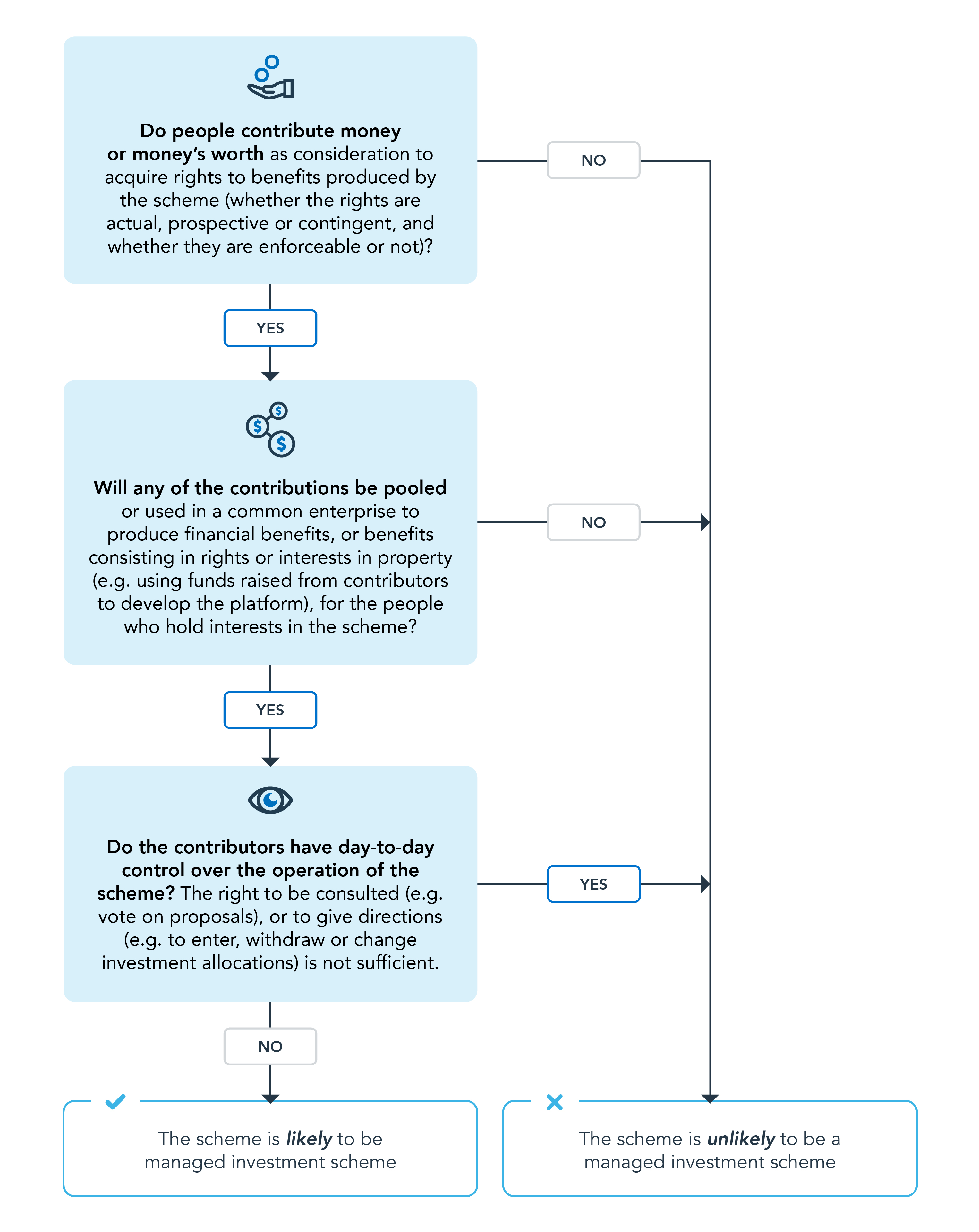
Figure 1 - text version
Step 1
Do people contribute money or money’s worth as consideration to acquire rights to benefits produced by the scheme (whether the rights are actual, prospective or contingent, and whether they are enforceable or not)?
- If NO: The scheme is unlikely to be a managed investment scheme.
- If YES: Proceed to Step 2.
Step 2
Will any of the contributions be pooled or used in a common enterprise to produce financial benefits, or benefits consisting in rights or interests in property (e.g., using funds raised from contributors to develop the platform), for the people who hold interests in the scheme?
- If NO: The scheme is unlikely to be a managed investment scheme.
- If YES: Proceed to Step 3.
Do the contributors have day-to-day control over the operation of the scheme?
(The right to be consulted (e.g., vote on proposals), or to give directions (e.g., to enter, withdraw or change investment allocations) is not sufficient.)
- If YES: The scheme is unlikely to be a managed investment scheme.
- If NO: The scheme is likely to be a managed investment scheme.
Typically, in Australia, traditional managed investment schemes (sometimes called managed funds) operate with a trust structure to hold the assets contributed by the investors (or purchased using those contributions). However, a trust structure is not required for the arrangement to be a managed investment scheme (some schemes are enterprise or contract-based schemes).
Application to digital assets
As noted above, ‘rights’ and ‘benefits’ should be interpreted broadly. If the digital asset represents an interest in a scheme with the three elements described above, the digital asset issuer is likely to be offering interests in a managed investment scheme.
In some cases, digital asset issuers may frame the entitlements received by contributors as a receipt for a pre-purchased service (e.g. lower trading fees, computer storage services). Whether such an arrangement may be a managed investment scheme depends on the specific facts.
Australian laws apply
If an issuer of a digital asset or a product involving digital assets is operating a managed investment scheme offered to retail investors, it will likely need to hold an AFS licence authorising it to act as a responsible entity, comply with the AFS licence obligations and comply with some additional obligations applying to responsible entities.
If a person issues a digital asset or a product involving digital assets and is operating a wholesale managed investment scheme, they may need to obtain an AFS licence with the correct authorisations and must have an appropriate process to ensure that only wholesale clients invest in the managed investment scheme. For guidance on licensing arrangements for issuers of wholesale managed investment schemes, see Information Sheet 251 AFS licensing requirement for trustees of unregistered managed investment schemes (INFO 251).
Part D includes more information about good practices for managed investment schemes offering exposure to digital assets, such as custody, registration and disclosure. See also Managed investment schemes.
Digital assets that are, or involve, an offer of a security
This section discusses when digital assets are, or involve, an offer of a security. We provide three examples that explore how the definition applies to digital assets and related products.
What is a security?
The most common type of security is a share. An option to acquire a share by way of issue is considered to be a ‘security’ under the Corporations Act. A share is a collection of rights relating to a company. There are a range of types of shares that may be issued. Most shares issued by companies that offer shares to the public are ‘ordinary shares’ and carry rights regarding the ownership of the company, voting rights in the decisions of the body, some entitlement to share in future profits through dividends, and a claim on the residual assets of the company if it is wound up.
Most shares issued in Australia also come with the benefit to shareholders of limited liability. For more information about shares, see Company share and shareholder rules and changes.
A debenture is also a ‘security’ under the Corporations Act. Debentures are a way for businesses to raise money from investors. The business issuing the debenture promises to repay the investor the money deposited with or lent to the business, usually with interest, at a future date. Debentures may be secured or unsecured.
Application to digital assets and ICOs
When an initial coin offering (ICO) is undertaken to fund a company (or to fund an undertaking that looks like a company) then the rights attached to the issued digital asset may fall within the definition of a security – which includes a share or the option to acquire a share in the future, or a debenture – or an interest in a managed investment scheme.
In 2017–2018, ICOs were an important process for primary market sales of digital assets. The process has similar characteristics to an initial public offering (IPO) or crowd-funding sale. Other approaches to sales and distribution of digital assets have since emerged.
The bundle of rights and benefits referred to above may help determine whether a digital asset sold during one of these approaches is a security (or an interest in a managed investment scheme – see Example 11). If the rights attached to the digital asset (which are generally found in the ‘white paper’ for the digital asset, but may be found in other materials) are similar to rights commonly attached to a share – such as an ownership interest in the body, voting rights in decisions of the body or some right to participate in profits of the body – then it is likely that the digital asset is a share. If the digital asset gives the purchaser a right to acquire shares in the company at a time in the future (e.g. if it lists on a licensed market) then this may be an option. If the digital asset represents an enforceable right to be repaid for money deposited with or lent to a company, then this may be a debenture.
Australian laws apply
Where it appears that an issuer of a digital asset is offering a security, the issuer will generally need to prepare a prospectus if the offering is to retail investors.
By law, a prospectus must contain all information that consumers reasonably require to make an informed investment decision. Generally, a prospectus should include audited financial information.
Where an offer document is, or should have been, a prospectus and that document does not contain all the information required by the Corporations Act, or includes misleading or deceptive statements, consumers may be able to withdraw their investment before the securities are issued or pursue the issuer and those involved in the sale of the security for any financial loss.
For more details about the information a prospectus should contain, see Regulatory Guide 228 Prospectuses: Effective disclosure for retail investors (RG 228).
If the digital asset offering is, or involves, a debenture and is sold to retail investors, further obligations apply under Chapter 2L of the Corporations Act. There is also specific ASIC guidance for disclosures to retail investors: see Regulatory Guide 69 Debentures and notes: Improving disclosure for retail investors (RG 69).
Digital assets that are, or involve, a derivative
This section discusses when digital assets are, or involve, a derivative. We provide two examples that explore how the definition applies to digital assets and related products.
What is a derivative?
Section 761D of the Corporations Act provides a broad definition of a derivative. It is an arrangement satisfying the following conditions:
- a party to the arrangement must, or may be required to, provide at some future time consideration of a particular kind or kinds to someone, and
- that future time is not less than the number of days, prescribed by regulations for this purpose, after the day on which the arrangement is entered, and
- the amount of the consideration, or the value of the arrangement, is ultimately determined, derived from or varies by reference to (wholly or in part) the value or amount of something else.
The definition in section 761D also includes a non-exhaustive list of examples of what the ‘something else’ may be. It could be, for example, a share, a share price index, a bond, a bond price index, a pair of currencies, a commodity, a basket of commodities, a digital asset or a digital asset index. ‘Consideration’ could be the delivery of other financial products.
The statutory definition of a derivative in section 761D includes some exceptions, such as:
- certain deferred sales of tangible property (section 761(3)(a))
- a ‘contract for the future provision of services’ (section 761(3)(b)),
that also need to be assessed to understand whether the digital asset or related product is a derivative.
Application to digital assets
An arrangement relating to a digital asset (which could be a digital asset itself) may be a derivative if it requires that a party provides (or might have to provide) some future consideration and the amount to be provided or value of the arrangement is itself based on, varies by reference to, or is derived from the price or value amount of something else (such as another asset, financial product, or market index).
Some examples of digital assets or related products that might be derivatives include:
- digital assets where the price references a ‘real-world’ asset (i.e. assets that are not ‘crypto native’ – whether or not that asset is a financial product, such as gold or real estate). This can include some digital assets such as some ‘algorithmic stablecoins’
- wrapped digital assets, which are digital assets where the price is derived from another digital asset. This can include wrapping between blockchains (i.e. between ‘Layer 1s’), and some processes to represent a digital asset on what are called ‘Layer 2s’, and
- contracts for difference (CFDs), options, forwards or futures that reference one or more digital assets, including perpetual futures.
The price of the digital asset does not have to precisely match the price of the underlying to be a derivative.
As noted above, we consider that many wrapped tokens are likely to be derivatives. As discussed in CS 32 Proposed relief for certain stablecoins and wrapped tokens, and extension of omnibus accounts for digital asset custody, we intend to grant class relief from the Corporations Act to distributors of eligible wrapped tokens from the requirement to hold an AFS licence, an Australian market licence and/or a CS facility licence.
Example 15: Traditional derivative
Scenario
Company N offers contracts that allow a client to speculate in the change in value of an underlying digital asset (with or without leveraged returns). Clients do not actually acquire an interest in the underlying digital asset, but they can make or lose money depending on whether the price of the underlying digital asset goes up or down.
Analysis
The contracts offered are likely to be derivatives.
Example 16: Wrapped token
Scenario
Company O offers a product that enables a crypto-asset, XYZ coin (only issued on one blockchain, its ‘native’ blockchain), to be represented on a different blockchain with added functionality and lower fees. It does this by developing, publishing and maintaining a smart contract to do what is called ‘wrapping’, where:
- a person holding an XYZ coin sends the coin to Company O’s address on the native blockchain, and
- Company O then issues a wXYZ token, on a different blockchain, sending the wXYZ token to the person’s address on the second blockchain.
The price of the wXYZ token can change in line with the price of the XYZ coin based on market conditions, but the XYZ coin and the wXYZ token may have slightly different prices at any one time. Company O outlines that any subsequent holder of the wXYZ token can redeem the XYZ coin with Company O by ‘burning’ (redeeming and cancelling) the wXYZ token.
Analysis
The wXYZ token is likely to be a derivative. This is because the value of the arrangement represented by the wXYZ token is ultimately determined, derived from, or varies by reference to (wholly or in part) the value of the XYZ coin, and none of the exceptions apply.
Australian laws apply
Where an issuer of a digital asset, or related product involving digital assets, is making an offer of a derivative they need to have an AFS licence with appropriate authorisations to issue that product (unless an exemption applies). Where a person provides other financial services in relation to derivatives, such as arranging or advising, then they need to have an AFS licence with appropriate authorisations to provide those services: see Part B.
Over-the-counter (OTC) transactions of derivatives, such as CFDs in digital assets and digital assets that are derivatives, by AFS licensees and other ‘reporting entities’ may be subject to the transaction reporting requirements: see Derivative transaction reporting. Further, each party to a derivative which is not issued on a financial market is taken to be an issuer of it: see section 761E(5) of the Corporations Act.
Digital assets that are, or involve, a non-cash payment facility
This section discusses when digital assets are, or involve, a non-cash payment facility. We provide two examples that explore how the definition applies to digital assets and related products.
What is a non-cash payment facility?
A person makes a non-cash payment if they make a payment, or cause a payment to be made, otherwise than by the physical delivery of Australian or foreign currency in the form of notes and/or coins (section 763D of the Corporations Act). A facility through which, or through the acquisition of which, a person makes (or can make) non-cash payments to more than one person is generally a financial product. The provision of financial services in relation to such facilities generally requires an AFS licence: see Regulatory Guide 185 Non-cash payment facilities (RG 185) for further guidance.
Many non-cash payment facilities involve arrangements where the client can make multiple payments over time using, for example, a debit card that is attached to an underlying deposit account or store of value. In such instances, the financial product is the facility that enables a payment to be made from the store of value, using that value as the medium of exchange. Each payment counts as a use of that facility and does not involve the creation of a separate financial product – for example, payment by:
- an account-to-account funds transfer
- using a facility for the direct debit of the account or use of the debit, or
- a pre-paid card in-store or online to make a payment from the account.
However, not all non-cash payment facilities involve a facility like this being established between the operator and client who initially acquired the facility. The concept of ‘makes non-cash payments’ in the Corporations Act also allows for the possibility of payments being made by passing the ownership (or control) of a non-cash payment facility itself from one person (the payer) to another person (the payee). These types of non-cash payment facility are a type of bearer instrument, as it is also an example of a facility ‘through which, or through the acquisition of which’ a person makes a payment.
While the structure or terms and conditions relating to a non-cash payment facility may not, in practice, allow the passing of ownership (or transferability) of the facility in this way, the legislation does allow for a facility to be designed in such a way. To illustrate this, the legislation touches on a number of scenarios involving products that are capable of being passed from an initial holder to subsequent holders as follows:
- the Corporations Act includes making payments by means of traveller’s cheques
- the Corporations Regulations specifically exclude, as a financial product, Australia Post money orders (which, without such exclusion, would likely amount to a non-cash payment facility) (reg 7.1.07F), and
- ASIC Corporations (Non-cash Payment Facilities) Instrument 2016/211 provides class relief from various obligations in Chapter 7 ordinarily applying to the provision of financial services relating to non-cash payment facilities in relation to ‘gift facilities’ as examples: see also RG 185.
Application to digital assets
The definition in the Corporations Act of when a person makes a non-cash payment is broad enough to cover performing monetary obligations by means other than fiat currencies. This can include payments using, for example, loyalty points or digital assets: see RG 185 at RG 185.38. In Australian Securities and Investments Commission v BPS Financial Pty Ltd [2024] FCA 45, the court found that Qoin’s wallet was a non-cash payment facility to make payments by way of a crypto asset (the Qoin token).
Whether or not a facility involving digital assets, and/or the digital asset itself, is a non-cash payment facility will depend on the terms and features of the arrangement.
Digital asset wallets, whether custodial or non-custodial, may be non-cash payment facilities where users can use the digital wallet to make payments to third parties. For example, some digital asset wallets have a ‘pay anyone’ feature that allows users to transfer digital assets to another person, whether another user of the same digital wallet service or a recipient using another digital wallet service (e.g. by nominating a destination address on a public blockchain).
Digital assets used in payments may also themselves be a non-cash payment facility. For example, many tokens are expressly designed to be used for, and are promoted as, a means to make payments between users. They are designed to be used as a store of value and a means of payment and, for this reason, are sometimes described as ‘electronic cash’. But this does not necessarily mean that all digital assets used for making payments are non-cash payment facilities themselves.
Further, there are some limitations to the scope of the financial product definitions in the Corporations Act that may affect whether something is a non-cash payment facility. For example:
- the ‘single payee’ exemption: see section 763D(2)(a)(i), and
- the incidental financial product exclusion: see section 763E.
We consider that certain ‘stablecoins’ are likely to be a non-cash payment facility.
As discussed in CS 32 Proposed relief for certain stablecoins and wrapped tokens, and extension of omnibus accounts for digital asset custody, we intend to grant class relief from the Corporations Act to distributors of eligible stablecoins from the requirement to hold an AFS licence, an Australian market licence and/or a CS facility licence.
Example 17: Digital asset wallets
Scenario 1
Company P offers a digital asset wallet product. Company P’s business model is centred on enabling clients to transfer their tokens to another address or digital asset wallet issued by Company P, or to any other address or digital asset wallet that accepts these tokens.
Company P controls the private keys associated with the blockchain addresses, acting on instructions from the customer to initiate the on-chain transfers. The terms and conditions, and Company P’s marketing material about this wallet promote the benefit to its clients of the convenience of ‘making payments to anyone’.
Scenario 2
As a variation, Company P offers a second digital asset wallet in the form of software for download to a customer’s phone or computer. The software enables the customer to create a blockchain address and private key. Company P has no access to, or knowledge of, the private keys created by the customer when interacting with the software. The second-version digital asset wallet also allows customers to transfer tokens as well as make payments to other digital asset wallets, whether held by the same customer or other persons.
Analysis
Both digital asset wallets may be financial products because they are non-cash payment facilities. Both wallets are a facility through which clients can make payments to third parties.
With the first wallet, the fact that Company P’s terms and conditions and marketing of the facility state that the users can make payments makes this version of the wallet more likely to be a non-cash payment facility.
However, even though Company P does not market the second digital asset wallet as a facility capable of making payments, the wallet could still be used to make non-cash payments, and this component of the second wallet may be a non-cash payment facility. Company P’s involvement (issuance of) or control over the second wallet is not relevant to whether the facility is a financial product. Depending on further details evidenced from other documentation, and the code for the wallet, which are relevant to matters such as how commonly the wallet is used to make non-cash payments, the incidental financial product exclusion in section 763E may apply.
Example 18: Non-interest-bearing stablecoin
Scenario 1
Company Q issues a digital asset token to Australians which is marketed as a non-interest-bearing ‘stablecoin’. The token is expected to maintain a stable price and value in Australian dollars (AUD), and the tokens are issued at par value in AUD (i.e. one token equals one AUD). Under the product terms and conditions, Company Q will redeem, or buy back, the tokens at par value in exchange for fiat money, on demand from any holder (subject to any relevant know-your-customer (KYC) requirements).
The money received by Company Q for the issue of the stablecoins (or the assets bought with that money) is recorded as an asset on their balance sheet and the requirement to repay is recorded as a liability.
Company Q uses the money received to purchase high-quality liquid assets (HQLA), such as Australian Government Securities, and holds the remainder in an account with an Australian authorised deposit-taking institution (ADI). No yields generated from Company Q’s dealings in the funds are passed on to clients.
Clients acquire the Company Q stablecoin either from Company Q or from a previous holder. The stablecoin is promoted as a quick and easy way to make payments, and as a form of ‘digital cash’. Many clients use it for this purpose and many merchants advertise that they accept transfer of these stablecoins into their digital asset wallet as a form of payment.
The identity of holders of Company Q stablecoins is not generally known to Company Q and holders do not generally have direct interaction with Company Q, unless redeeming stablecoins directly with Company Q.
Scenario 2
As a variation, Company Q offers a second USD denominated stablecoin which is also marketed for use in payments. Under the relevant trust deed, Company Q will redeem, or buy back, the US dollar (USD) tokens at par value in exchange for fiat money, on demand from any holder (subject to any relevant KYC requirements). The tokens are issued at par value in USD and the money received by Company Q for the issue of the USD stablecoins is initially held in a special purpose trust, with each token representing an interest in that trust. As set out in the initial white paper, Company Q uses most of the money received to purchase low-risk investments (e.g. US Treasuries) and holds the remainder in a trust account with a US bank.
Analysis
Company Q’s stablecoins are both likely to be a financial product, being a non-cash payment facility. While they are not account-based products in the traditional sense, one of their intended and widespread uses is that ownership of the stablecoins can be transferred from a client to a merchant as an effective means of payment.
The stablecoins are also linked to a single currency (either AUD or USD) and are redeemable from Company Q at any time by any holder (subject to conditions). The currency to which the stablecoin is linked does not change the financial product status of the stablecoin. The features such as non-yield bearing and backed one-to-one with HQLA also mean the stablecoins are unlikely to have another type of financial product status (such as a managed investment scheme or derivative).
Australian laws apply
If you are providing financial services in relation to a non-cash payment facility (e.g. providing advice or dealing), an AFS licence may be needed. For general information on non-cash payment facilities, including the exemptions that can apply, see RG 185, and see Part B on financial services.
How overseas digital asset categories translate to the Australian context
Some international regulators have issued guidance on the application of their securities, payments and financial services laws to digital assets, and have defined the function of a range of digital assets (e.g. security tokens, utility tokens and exchange tokens). These categorisations do not necessarily translate to equivalent products in Australia.
It is important to always consider the particular rights and benefits of an individual digital asset in relation to current Australian law to determine whether it is regulated as a financial product or whether the services you provide are regulated as the provision of financial services in Australia.
The definition of a financial product in Australia is often broader than comparable concepts in other jurisdictions. Similarly, the definition of financial services in Australia can vary compared to other jurisdictions.
It is your responsibility to understand and comply with all relevant and applicable Australian laws in relation to the products and services you provide or propose to provide.

What is a financial service?
The Corporations Act outlines a range of ‘financial services’ that can be provided in relation to a financial product.
The following list of examples represents only the core of financial services and is not comprehensive:
- dealing in a financial product – this includes a range of conduct including applying for or acquiring, varying, disposing and underwriting. It also includes issuing a financial product and arranging
- providing financial product advice (general and personal advice)
- making a market for a financial product, and
- providing a custodial or depository service.
Persons are generally required to hold an AFS licence to carry on a financial services business in Australia.
Financial services involving digital assets
This section describes different ways that financial services may be provided in respect to digital assets or related products that are financial products.
When are you providing advice in relation to digital assets that are financial products?
A person may be providing advice if they recommend or state an opinion with the intention of influencing the consumers’ decision about the financial product. For example, by:
- making comparisons between two digital assets where at least one of them is a financial product, and/or
- making comparisons between a digital asset and a traditional financial product by giving advice about the relative merits of investing in certain digital assets versus certain shares: see Information Sheet 269 Discussing financial products and services online (INFO 269).
We have set minimum training standards for financial product advisers: see Regulatory Guide 146 Licensing: Training of financial product advisers (RG 146).
Your financial product advisers are required to have specialist knowledge and training about the specific financial products they represent. When considering the digital nature of a financial product, the general principle is that its electronic design does not impact the advice as a financial product.
We recommend that advisers have a working knowledge of the technology underpinning digital assets that are financial products and related financial products. They should be able to explain the extent that the technology changes the risks or benefits that are specifically in the interest of consumers.
When are you dealing in relation to digital assets that are financial products?
‘Dealing’ includes the acts of buying and selling (whether for yourself or on behalf of another person) and issuing (i.e. creating and making available) a financial product.
Dealing is the service provided by a person of buying and selling pre-existing digital assets from or to clients, which may consist of consumers or other businesses. Arranging for another person to deal in financial products is also a form of dealing. For example, a business that assists people with buying or selling digital assets that are financial products may itself be dealing in financial products (e.g. acting as a broker). However, subject to some exceptions, dealing on your own behalf is not a financial service.
Issuing is the part of dealing where a person or company supplies a digital asset that is a financial product, or a financial product related to digital assets.
Note: The use of the term ‘arranging’ in the context of the Corporations Act does not necessarily have the same meaning in other legislative contexts. See Regulatory Guide 36 Licensing: Financial product advice and dealing (RG 36).
When does a digital asset service involve market making?
A person generally makes a market when they regularly state prices at which they offer to buy or sell financial products on their own behalf, with others able to respond to those offers. This business model is common both for traditional financial products and digital assets. Where some or all of the digital assets involved are financial products, the market-making business will be providing a financial service.
When does a digital asset service involve custody?
A person provides a custodial or depository service and holds financial products or a beneficial interest in the financial product on trust for, or on behalf of, their clients. If this service is provided in relation to digital assets when some or all of them are financial products, the custodial service will be a financial service. The manner in which the assets are held, subject to the terms of the arrangement, is important in understanding if there is a financial service being offered.
Where a person controls the private keys related to an address on a public blockchain, they will likely be providing a custodial or depository service. Offering a ‘self-custody’ solution, or self-hosted wallet product, is unlikely to amount to providing a custodial or depository service.
See Regulatory Guide 133 Funds management and custodial services: Holding assets (RG 133) for more information on the obligations for custodians.
The obligations on custodial or depository service providers are principles-based and apply to custody of any financial product, regardless of its form. They are also flexible for the nature and scale of the business, including the balance between technological, business and personnel requirements. We have provided guidance on these obligations to reflect the different structures of holding digital assets for clients in RG 133.
Section G of RG 133 outlines the requirements of custodians to hold client assets. The regime allows for omnibus holding of client assets for certain types of financial products under certain conditions. Reflecting the structure of digital asset markets and systems, we have extended the omnibus holdings exemption to allow entities that provide custody of digital assets that are financial products to hold those digital assets in omnibus arrangements. Entities are still required to separate client assets from firm assets. Custodial or depository service providers also have specific financial requirements as set out in Regulatory Guide 166 AFS licensing: Financial requirements (RG 166). The Financial requirements section of this information sheet provides guidance on the net tangible assets (NTA) requirement relating to custodial or depository services, including guidance in relation to ‘incidental custody’ for the purposes of the NTA requirements.
In addition, Section F of RG 133 provides good practice guidance for custodial or depository service providers and responsible entities of registered managed investment schemes that hold digital assets.
Applying for an AFS licence for financial services involving digital assets
This section considers how the requirements for AFS licence applications apply to financial services involving digital assets that are financial products.
Entities are generally required to hold an AFS licence, or operate as an authorised representative of an AFS licensee, to carry on a financial services business in Australia. You need to have the appropriate authorisations before you undertake the services that require such a licence.
Regulatory Guide 1 Applying for and varying an AFS licence (RG 1) includes guidance on ASIC’s licensing assessment policy settings and what licence authorisations you may require. The range and mix of licences you will require will depend on:
- what type of financial products you are providing financial services for
- what financial services you are providing, and
- whether your clients are retail or wholesale clients.
Some entities may be providing a financial service in Australia but do not require a licence for that service due to exemptions from the Corporations Act. These can differ by product and service type. Please refer to the relevant regulatory guides for the specific financial product and service.
RG 1 and other regulatory guides also provide guidance on how to apply for your licence. This includes what types of documentation and information you will need to provide to demonstrate organisational competence to offer the financial services.
When engaging with RG 1, you will need to understand which financial product(s) you are applying to provide financial services for. In identifying these financial products, you will need to assess both the digital assets, and any associated arrangements you offer to customers. For example, if a digital asset or related product is a non-cash payment facility, you will select the ‘non-cash payment products’ product type, and the services that you are intending to provide for that product. We will also consider providing a tailored licence authorisation where the digital asset or related product is novel: see RG 1 at RG 1.65(k).
It is important to note that having an AFS licence does not authorise you to provide any and all financial products and financial services. Rather, you are limited to offering the financial products and financial services that are detailed by the authorisations on your licence.
Where you are providing a financial service in relation to digital assets that are financial products, we may impose some specific additional or altered licence conditions and obligations. The extent of differences with the traditional financial products and services will depend on the product and service applied for.
Professional indemnity insurance
If you provide financial services to retail clients, you must have arrangements for compensating those clients. The primary way to comply with this obligation is to have professional indemnity insurance: see Regulatory Guide 126 Compensation and insurance arrangements for AFS licensees (RG 126).
Consistent with our general approach, where you show genuine attempts to obtain professional indemnity insurance but are unable to do so, alternative arrangements may be considered on a case-by-case basis, as long as the alternative arrangements provide a comparable level of protection: see RG 126 at RG 126.64.
Responsible managers
You must comply on an ongoing basis with the organisational competence obligation in section 912A(1)(e) of the Corporations Act, and must demonstrate compliance with this obligation in your licence application: see Regulatory Guide 105 AFS licensing: Organisational competence (RG 105).
We assess compliance with this obligation during the licensing process by evaluating the knowledge and skills of the nominated responsible managers. For example, responsible managers must have experience in the products and services offered, an understanding of the technology, and an understanding of the regulatory requirements of an AFS licensee. Compliance with this obligation will depend on the nature, scale and complexity of your business, including its size, the financial services and products provided, and the structure of the relevant roles to this obligation.
We may consider unregulated experience for the purposes of satisfying Option 5 of RG 105 for responsible managers: see, for example, Regulatory Guide 262 Crowd-sourced funding: Guide for intermediaries (RG 262). Any unregulated experience must still be of an acceptable level to satisfy ASIC that the responsible manager(s) has the appropriate knowledge and skills for their role.
Experience of a nominated responsible manager for the purposes of demonstrating organisational competence will be assessed on a case-by-case basis and in conjunction with the experience demonstrated by any other nominated responsible managers.
The required number of responsible managers for digital assets will vary based on the nature, scale, and complexity of your business, and the experience mix and capacity of nominated responsible managers to perform relevant tasks.
As a transitional approach to compliance with the organisational competency obligation, we will assess on a case-by-case basis whether the combination of two or more people may meet the responsible managers requirement. This could involve one responsible manager overseeing the regulatory aspects of the business while the other oversees operational business decisions in relation to the digital assets. The second responsible manager may have unregulated digital asset experience. We will require the group of responsible managers as a whole, and the individual responsible managers for their roles, to demonstrate adequate capacity to fulfil their obligations for the entity in question.
This is a transitional approach. We expect the pool of responsible managers to broaden as more individuals obtain relevant mixes of knowledge, skills and experience in both regulation and digital assets.
Financial requirements
AFS licensees are required to comply with the base level financial requirements: see RG 166. Additional requirements may apply (e.g. if you hold client money or property) and tailored financial requirements may apply, based on your licence authorisations. In certain circumstances additional financial requirements are imposed as NTAs, including when providing a custodial or depository service: see ASIC Corporations (Financial Requirements for Custodial or Depository Service Providers) Instrument 2023/648.
A provider of a custodial or depository service typically requires at least $10 million in NTA except where the service provider outsources this to a sub-custodian and/or when the custodial or depository service is ‘incidental’ (i.e. not the primary financial service) to the provision of other financial services. Where custody is ‘incidental’ the NTA obligation is $150,000, or where the service is incidental and you do not hold physical custody then the NTA obligation may be nil: see Table 15 in RG 166.
Whether a custodial or depository service is ‘incidental’ depends on specific circumstances. For instance, we may consider your custody service to be ‘incidental’ for the purposes of being an ‘incidental provider’ under ASIC Instrument 2023/648 if providing custody is:
- for the purpose of facilitating the dealing or market making of, or operating a market in a digital asset that is, a financial product (e.g. a derivative), and
- as an ancillary service you are not earning revenue from custody, or part of an arrangement that is a non-cash payment facility and no revenue is generated from the custody service (e.g. revenue is from transaction fees).
A service is unlikely to be ‘incidental’ if it is a primary financial service, such as a custodial wallet service, where fees are charged in relation to the assets held in the wallet (rather than fees for transactions or transfers of those digital assets). Some businesses may offer one or all of these different custodial arrangements across a mix of products and services.
One component of the NTA requirement is that at least 50% of the required NTA must be held in cash or cash equivalents. We may consider relief on an individual basis where a digital assets business cannot obtain banking services to facilitate this.
Doing financial services business in Australia
Persons from outside Australia that wish to engage in a financial services business in Australia need to consider:
- whether you are ‘carrying on a financial services business’ in this jurisdiction, and are therefore required to be licensed and abide by the product disclosure requirements and design and distribution obligations, or
- have other obligations under legislation administered by ASIC: see Regulatory Guide 121 Doing financial services business in Australia (RG 121).
Note: Where an overseas digital asset issuer is providing a financial service from outside Australia, without engaging in conduct that is intended to induce people in Australia, there is no requirement for the issuer to prepare a Product Disclosure Statement (PDS), subject to consideration of any anti-avoidance measures, or comply with the design and distribution obligations regime.

Part C: Other things to consider when offering digital assets
Are you complying with all relevant Australian laws on an ongoing basis?
Entities need to ensure they comply with all relevant Australian laws when offering digital assets. This includes ensuring that all the documents and information they provide to consumers, regardless of the media they use, comply with relevant laws including the Corporations Act, ASIC Act and Australian Consumer Law, as well as anti-money laundering and counter-terrorism financing (AML/CTF) and know-your-customer (KYC) obligations.
Whether or not a financial product is involved, promoters must always ensure that the marketing of and disclosures about digital assets do not involve misleading or deceptive conduct or statements. Entities should seek professional advice (including legal advice) on all the facts and circumstances of the issue or sale of digital assets.
As the design or features of a digital asset can change over the course of the product development life cycle, entities are expected to seek professional advice and ensure ongoing compliance with the law.
What is misleading or deceptive conduct in relation to a digital asset?
Australian law prohibits misleading or deceptive conduct in trade or commerce. This applies regardless of whether or not the digital asset is a financial product. Australian laws and regulations that prohibit misleading or deceptive conduct may apply even if a digital asset is issued, traded or sold offshore. It is a serious breach of Australian law to engage in misleading or deceptive conduct.
Care should be taken to ensure that promotional communications about a digital asset do not mislead or deceive consumers and do not contain false information. When a person makes representations about fundraising for a project, but they are inconsistent with the rights and benefits in the related terms and conditions or offering materials, the person may be at risk of having made false or misleading statements. It is important to ensure that ongoing disclosures are kept up to date – failure to do so will increase the risk that the information provided about the digital asset could mislead or deceive consumers.
Digital assets that are financial products
For digital assets that are financial products, the ASIC Act and the Corporations Act include prohibitions against misleading or deceptive conduct.
Regulatory Guide 234 Advertising financial products and services (including credit): Good practice guidance (RG 234) contains guidance to help businesses comply with their legal obligations not to make false or misleading statements or engage in misleading or deceptive conduct.
Digital assets that are not financial products
For digital assets that are not financial products, the same prohibitions against misleading or deceptive conduct apply under Australian Consumer Law. The Australian Competition and Consumer Commission (ACCC)’s Advertising and selling guide provides guidance on how to ensure advertising complies with Australian Consumer Law.
Are your clients ‘retail’ investors?
The Corporations Act imposes additional requirements for entities that provide financial services to retail clients. Entities are expected to know who their investors are to justify a conclusion that exemptions under the Corporations Act for ‘wholesale’ or ‘sophisticated’ investors versus retail clients apply to their financial services. Where retail clients are involved, entities must apply for an AFS licence that specifically authorises providing financial services to retail clients.
Some important additional requirements are:
- additional disclosures through PDSs and financial services guides (FSGs)
- the design and distribution obligations
- internal and external dispute resolution arrangements, and
- compensation requirements.
There are also some additional requirements for specific types of financial products—for example, see Digital assets that are, or involve, interests in a managed investment scheme for responsible entities of registered managed investment schemes.
What is the link with crowd-sourced funding?
Digital assets are sometimes issued as a form of crowd funding for building blockchain, distributed ledger, and other products or services (including funds management).
Crowd funding by selling digital assets in an ICO is not the same as ‘crowd-sourced funding’ (CSF) regulated under the Corporations Act. Care should be taken to ensure the public is not misled about the application of the CSF laws to an ICO or digital assets issued in that process. There are specific laws for the CSF regime which reduce the regulatory requirements for public fundraising from retail investors while maintaining appropriate investor protection measures.
The laws require providers of CSF services to hold an AFS licence authorising them to provide this service. This is not an exhaustive discussion of all the relevant Australian laws that apply in relation to providing CSF. It is the responsibility of the entities involved to ensure they comply with all relevant Australian laws. For more information, go to Crowd-sourced funding on the ASIC website.
What are ASIC’s discretionary powers?
ASIC has discretionary powers to grant relief (i.e. by exemption or declaration) from certain legislative provisions. ASIC’s approach to granting relief is outlined in Regulatory Guide 51 Applications for relief (RG 51).
Relief can be individual or for a class of persons or products.
Generally, we do not have power to grant retrospective relief. To the extent that we can give relief from future consequences of past conduct, our policy is not to do so.
In assessing a relief application, we attempt to weigh the commercial benefit and any net regulatory benefit or detriment that would flow from granting the relief sought on the conditions proposed.
You can also ask us to grant a no-action letter. This is a letter in which we state to a particular person that we do not intend to take regulatory action over a particular state of affairs or particular conduct. It is not, however, a guarantee that we will not take action in the future, nor is it intended to affect the rights of third parties to take action in relation to any contravention. It is not legal advice and may be withdrawn at any time. See Regulatory Guide 108 No-action letters (RG 108).
Additional guidance for complying with your ongoing obligations as an AFS licensee
This section explores key issues relating to AFS licensee obligations. The topics covered in this section are not exhaustive and it is the responsibility of AFS licensees to be aware of and comply with all the obligations under the Corporations Act.
Client money
Holding client money is subject to the client money regime in Part 7.8 of the Corporations Act. While having a focus on client money in OTC derivatives, Regulatory Guide 212 Client money relating to dealing in OTC derivatives (RG 212) provides a summary of what is and is not client money and outlines when holding client money is regulated under Chapter 7 of the Corporations Act: see RG 212 at RG 212.2–RG 212.4.
You must hold client money to which the client money regime applies in a separate trust account with an Australian ADI. This separation of client funds helps protect retail investors against misuse or loss.
If you show genuine attempts to meet the client money obligations but have been unable to do so (e.g. where you are unable to source a trust account from an Australian ADI or where you are unable to immediately distinguish between whether client funds are related to financial or non-financial products), relief may be considered on a case-by-case basis. If you can demonstrate that any alternative arrangement will provide equivalent customer protections to the client money regime, relief may be considered: see RG 51. Alternative arrangements should focus on, but not be limited to, identifying and segregating client money quickly, keeping client money separate from ‘house’ money, implementing effective controls to protect client money, maintaining sufficiently detailed and accurate financial records, and negligible default and credit risk consistent with a trust account at an ADI.
In certain circumstances, such as when the digital asset is an OTC derivative, the ASIC Client Money Reporting Rules 2017 may apply. If you hold ‘reportable client money’ you must comply with a number of record-keeping, reconciliation and reporting requirements (see Information Sheet 226 Complying with the ASIC Client Money Reporting Rules 2017 (INFO 226)), noting there are additional reporting requirements when providing OTC derivatives (see RG 212).
Conflicts of interest
You are responsible for ensuring you implement adequate arrangements for the management of conflicts of interest: see section 912A(1)(aa) of the Corporations Act and Regulatory Guide 181 Licensing: Managing conflicts of interest (RG 181). What constitutes adequate arrangements will depend on the nature, scale and complexity of your business. In addition, you are required to disclose conflicts in various documents including the PDS and FSG.
Conflicts of interest may be more prevalent in certain digital asset businesses due to their vertically integrated structures. For instance, a digital asset business might run its own blockchain, issue its own token(s), provide brokerage services, provide custody of assets, trade on its own account, operate a platform for trading digital assets (including as the market maker, market operator and settlement system), provide lending services (including asset lending), and offer related products and services (e.g. a stand-alone digital asset wallet, or separate derivatives). These activities could be conducted by the same entity, or by related entities within the same corporate group. Such structures can introduce perceived, potential and actual conflicts that should be considered by the licensee including conflicts associated with proprietary trading, self-listing and dealing in a token created by the digital asset business. In traditional financial services many of these functions are typically conducted by separate entities.
To manage the risk of conflicts of interest, you could consider:
- nominating a person or persons to take responsibility for ensuring conflicts of interest management arrangements are implemented, reviewed and updated
- having robust systems to not preference related party digital assets
- whether the risk can be reduced by separating each business unit into individual legal entities (platform operator, market maker, principal trader) and addressed if necessary, and
- having appropriate processes in place to promote transparency of transactions such as an OTC counterparty or exchange that a transaction was directed to. We view it as good practice to disclose to customers the method and exact timing of execution and have controls in place to prevent, or deal with, incentive payments (e.g. shelf space fees, commissions, listing fees, payment for order flow).
Disclosure
Issuers of digital assets that are financial products may be subject to the product disclosure requirements in Part 7.9 of the Corporations Act. Regulatory Guide 168 Disclosure: Product Disclosure Statements (and other disclosure obligations) (RG 168) gives guidance on preparing disclosure documents and provides good disclosure principles to help consumers make better informed decisions about financial products. Also see Regulatory Guide 175 AFS licensing: Financial product advisers—Conduct and disclosure (RG 175) for personal or general advice obligations.
Design and distribution obligations
The design and distribution obligations are intended to help retail consumers obtain appropriate financial products. They apply in circumstances involving retail product distribution conduct. Issuers and distributors that are captured by the design and distribution obligations are required to have a consumer-centric approach to the design and distribution of financial products, including digital assets that are financial products: see Regulatory Guide 274 Product design and distribution obligations (RG 274). In particular:
- issuers must design financial products that are likely to be consistent with the likely objectives, financial situation and needs of the consumers for whom they are intended – this includes developing a target market determination (TMD)
- issuers and distributors must take ‘reasonable steps’ that are reasonably likely to result in financial products reaching retail consumers in the target market defined by the issuer, and
- issuers must monitor consumer outcomes and review products to ensure that retail consumers are receiving products that are likely to be consistent with their likely objectives, financial situation and needs.
Where the design and distribution obligations apply, issuers of a digital asset that is a financial product have an obligation to prepare a TMD and have distribution conditions that make it reasonable to conclude that it is likely that retail consumers who acquire the financial product will be in the target market. While an issuer may not retain direct control over assets issued on a blockchain network, it must take reasonable steps that will, or are reasonably likely to, result in a distribution being consistent with the TMD. You must notify ASIC of significant dealings in the product that are not consistent with the TMD within 10 business days of becoming aware of the inconsistency.
You can be both an issuer and distributor, such as a platform that sells its own tokens and operates a trading platform. Distributors must maintain complete and accurate distribution records.
Where the design and distribution obligations apply, distributors of digital assets that are financial products have an obligation to take reasonable steps to distribute a financial product in line with an issuer’s TMD.
When a digital asset is a financial product but the issue or sale of the product does not require a PDS or a TMD (for example, if the offers for the issue or sale of the product are not received in this jurisdiction and the issues are not made in this jurisdiction) distributors are not subject to the design and distribution obligations (noting other obligations may apply to the distribution).
Dispute resolution
If you are providing financial services to retail clients, you must have and comply with an internal dispute resolution (IDR) procedure that meets the standards or requirements made or approved by ASIC (see Regulatory Guide 271 Internal dispute resolution (RG 271)) and be a member of the Australian Financial Complaints Authority (AFCA) (see Regulatory Guide 267 Oversight of the Australian Financial Complaints Authority (RG 267).
Good practice guidance for AFS licensees providing services for digital assets that are not financial products
We recognise that AFS licensees may be providing services in relation to digital assets that may not be financial products. In such cases, you may consider:
- managing conflicts of interest in relation to non-financial digital assets in line with RG 181
- providing custody of non-financial digital assets with consideration to the RG 133 operational requirements, and
- offering the same internal and external dispute resolution process across your entire business.
This good practice recommendation may help you to mitigate some of the risks of not complying with your AFS licence obligations as a result of misclassifying a financial product digital asset as a non-financial product digital asset, uplift consumer protections, and reduce the burden of running separate processes for non-financial and financial product digital assets.

What is a financial market?
A financial market is a facility through which offers or invitations to acquire or dispose of financial products are regularly made or accepted. Anyone who operates a financial market in Australia must obtain an Australian market licence to do so or otherwise be exempted from the requirement to hold an Australian market licence: see Regulatory Guide 172 Financial markets: Domestic and overseas operators (RG 172).
Where a digital asset is a financial product, then any platform that enables consumers or other persons to make or accept offers to buy (or be issued) or sell these digital assets may involve the operation of a financial market. You need just one financial product trading on your market to mean you are operating a financial market. It is important for you to carefully consider what products you allow for trading.
Depending on the conduct involved, you may not be operating a market – for example, if you are acting as a market maker or broker (i.e. making or accepting offers to buy or sell digital assets that are financial products on your own behalf, or on behalf of one party to the transaction). A person undertaking this type of conduct, for example, would typically be required to hold an AFS licence rather than a market licence: see section 767A(2)(a) of the Corporations Act, RG 172 and Part B.
To operate a financial market in Australia, the platform operator will need to hold an Australian market licence unless covered by an exemption: see, for example, Information Sheet 217 Licensing relief for low volume financial markets (INFO 217). Platform operators must not allow financial products to be traded on their platform without having the appropriate licence as this may amount to a significant breach of the law.
If you operate an overseas platform that does not have an Australian market licence, you must ensure that it does not operate as a financial market in Australia (unless you are exempted from the requirement to hold an Australian market licence). This may require you to take steps to prevent Australian clients from accessing financial products on your platform.
These steps include (but are not limited to):
- removing references and links
- placing additional warnings and disclosures on the relevant webpages and apps
- screening out Australian clients as part of your KYC processes (e.g. whitelisting wallets), and
- introducing geographically based IP restrictions (geo-blocking).
For more information about financial markets, go to Markets on our website.
What is a CS facility?
A CS facility in the Corporations Act is defined as a facility that provides a regular mechanism for the parties to transactions relating to financial products to meet obligations to each other that arise from entering into a transaction, where the obligations are of a kind prescribed by the regulations. Regulatory Guide 211 Clearing and settlement facilities: Australian and overseas operators (RG 211) provides details on when you need a CS facility licence or exemption. CS facilities include central counterparties and settlement systems.
ASIC and the RBA are co-regulators of CS facilities in Australia and have separate, but complementary, responsibilities for licensing and supervising licenced CS facilities.
Depending on how transactions in digital assets that are financial products are cleared and/or settled, you may also be operating a CS facility and require a CS facility licence: see RG 211.

Part E: What to consider when offering retail investors exposure to digital assets via a regulated investment vehicle
This section provides guidance to issuers of investment products that provide retail investors with exposure to digital assets.
There are many different types of investment vehicles available to retail investors in Australia. The types commonly accessed by investors include:
- exchange traded products (ETPs), such as exchange traded funds (ETFs) and structured products (SPs)
- listed investment companies (LICs)
- listed investment trusts (LITs), and
- unlisted investment funds.
You must be mindful that there are specific legal obligations that apply to the different kinds of investment products you may be operating and offering. For example, ETFs, LITs and unlisted investment funds are managed investment schemes. SPs are generally securities or derivatives. LICs are public companies. Each of these are regulated by ASIC under the Corporations Act, but the regulatory obligations can differ.
In addition, except for unlisted investment funds, these products are typically traded on licensed Australian financial markets. Market operators play an important gatekeeper role in assessing the suitability of products that are admitted to their markets. If you intend to admit your product to a market, the respective market operator will have requirements you must meet.
The discussion below provides information on good practices for different types of investment products that provide exposure to digital assets. Issuers of ETPs that reference digital assets should also refer to the additional good practices specific to digital asset ETPs set out in Information Sheet 230 Exchange traded products: Admission guidelines (INFO 230).
While this guidance is primarily directed to entities providing digital asset investment products and services to retail investors, it is also good practice for providers of products to wholesale investors to apply this guidance, with a focus on custody and risk management.
Managed investment schemes
Responsible entities (REs) and retail managed investment schemes are regulated under Chapter 5C of the Corporations Act. REs play a crucial role in ensuring the health of, and confidence in, the financial system. They are entrusted with the funds of their investors and must comply with their legal obligations as REs, including to act in the best interests of members of the scheme.
There are certain key matters that REs must consider when investing the funds of their investors into digital assets, particularly in relation to custody, risk management and disclosure. These key matters are relevant, whether or not the digital assets are financial products.
Custody
The RE of a registered scheme must hold scheme property on trust for members: see section 601FC(2) of the Corporations Act. Further obligations in relation to custody are set out in ASIC Corporations (Asset Holding Standards for Responsible Entities) Instrument 2024/16. Regulatory guidance in relation to these obligations is set out in RG 133.
Asset holders also need to comply with financial requirements set out in ASIC Corporations (Financial Requirements for Responsible Entities, IDPS Operators and Corporate Directors of Retail CCIVs) Instrument 2023/647. Regulatory guidance in relation to these obligations is set out in RG 166. Generally, this will mean that the RE, or its custodian engaged to hold the scheme property, will be required to hold minimum NTA of A$10 million.
In meeting these minimum requirements when dealing with digital assets, we have provided good practice in RG 133, Part F.
Risk management
An RE, as an AFS licensee, is required to do all things necessary to ensure that the financial services covered by the licence are provided efficiently, honestly and fairly: see section 912A(1)(a) of the Corporations Act. Further, under section 912A(1)(h), an AFS licensee is required to have adequate risk management systems. Regulatory guidance in relation to these obligations is set out in Regulatory Guide 259 Risk management systems of fund operators (RG 259).
In meeting these minimum requirements in relation to digital assets, we consider it good practice for REs to carefully consider the digital asset exchanges used by them or their service providers to access digital assets. In particular:
- the RE should be satisfied, based on reasonable due diligence, that any digital asset exchange it relies on:
- is a digital currency exchange (DCE) provider registered with AUSTRAC, if required, or is regulated by one or more laws of a foreign country giving effect to the Financial Action Task Force recommendations relating to customer due diligence and record-keeping, and
- implements risk-based AML/CTF systems and controls that are supervised or monitored by a body empowered by law to supervise and enforce the customer due diligence and record-keeping obligations, and
- the RE should ensure that authorised participants, market makers and other service providers that trade digital assets in connection with the product do so on digital asset exchanges that meet the same standard as above.
The AML/CTF obligations, among other things, require entities to have customer identification procedures and aim to reduce the risk of digital assets being used to support criminal activity.
Research also suggests that market integrity issues are more prevalent on digital asset markets with lower levels of regulation, compliance and transparency.
The RE is responsible for ensuring its risk management systems appropriately manage all other risks posed by digital assets. Among other things, this could include implementing or applying relevant standards published by Australian and international organisations as they develop.
Disclosure
Part 7.9 of the Corporations Act sets out the obligations that apply to an RE as an issuer of a PDS. Further guidance about disclosure is set out in RG 168 and issuers should refer to the ‘Good disclosure principles’ outlined in Section C.
Relevantly, section 1013D of the Corporations Act requires that a PDS must include information – about any significant risks associated with holding the product – that a retail client would reasonably require to make a decision whether to buy the financial product.
In the context of investment products that invest in, or provide exposure to, certain digital assets, we consider there must be sufficient information about the characteristics and risks of those digital assets in the PDS. There must also be sufficient information about how the product is intended to operate and how it is expected to generate a return for investors.
Types of matters that may be relevant in meeting these minimum requirements may include:
- characteristics of digital assets
- the technologies that underpin digital assets, such as blockchains, distributed ledger technology, cryptography and others
- how digital assets are created, transferred and destroyed
- how digital assets are valued and traded, including whether the digital assets will be ‘staked’, and
- how digital assets are held in custody.
- risks of digital assets
- market risk – historically, digital assets have demonstrated that their investment performance can be highly volatile and there is a risk they could have little to no value in the future
- pricing risk – it may be difficult to value some digital assets accurately and reliably for reasons including the nature of their trading, susceptibility to manipulation, and a lack of identifiable fundamentals. Some digital assets may be purely speculative assets
- immutability – most digital assets are built on immutable blockchains, meaning that an incorrect or unauthorised transfer cannot be easily reversed and can only be undone by the recipient agreeing to return the digital assets in a separate transaction
- political, regulatory and legal risk – government and/or regulatory action may affect the value of digital assets held by the scheme
- custody risk – the private keys may be lost or compromised, resulting in digital assets being inaccessible or accessed by unknown third parties without authorisation
- cyber risk – the nature of digital assets may mean they are more susceptible to cyber risks than other asset classes, and
- environmental impact – to the extent that some digital assets have a large environmental impact, this may raise other risks, such as increased regulation or negative market sentiment, which could affect the value of digital assets held by the scheme.
Note: For the avoidance of doubt, this list does not represent mandatory matters for disclosure and should only be regarded as illustrating the types of matters that may be relevant to REs when complying with their disclosure obligations. REs must determine what is appropriate disclosure in the context of the characteristics, operations and risks of their product.
Licensing of scheme operators and registration of schemes
Operators of wholesale schemes that hold digital assets will generally need to hold an AFS licence or be exempt from the requirement to hold a licence. Operators of retail schemes that hold digital assets will need to hold an AFS licence to ‘operate a registered scheme’ where the investors in that scheme are retail.
For general information about applying for an AFS licence, see RG 1 which provides an overview of the application process and information on supporting documents.
We expect that applicants proposing to operate registered schemes that hold digital assets (whether the scheme holds one or more digital assets) will initially apply for ‘named scheme’ authorisation. This authorises the licensee to operate only the specific digital asset registered scheme(s) named on the licence.
Consistent with RG 105, we expect applicants to operate two named digital asset registered schemes for at least two years before we will consider granting them a broader ‘kind scheme’ authorisation for digital assets. The ‘kind scheme’ authorisation allows the licensee to operate multiple digital asset schemes without needing to vary the licence with each new scheme.
When applying for these authorisations, the applicant is required to select what kind(s) of assets the scheme will hold. For registered managed investment schemes that will hold digital assets, the applicant should select:
- for digital assets that are not financial products, the ‘crypto-asset’ asset kind, or
- for digital assets that are also financial products, the asset kind which corresponds to the digital asset class of financial product – for example, the ‘financial assets’ or ‘derivatives’ asset kinds.
To establish the ‘crypto-asset’ asset kind to administer our licensing functions we have defined ‘crypto-asset’ as ‘a digital representation of value or rights (including rights to property), the ownership of which is evidenced cryptographically and that is held and transferred electronically by:
- a type of distributed ledger technology, or
- another distributed cryptographically verifiable data structure.’
Note 1: This definition is deliberately broad to capture the range of assets that could be held by a managed investment scheme. Without limitation, it is intended to encapsulate the full range of ‘digital assets’, ‘crypto-assets’, ‘coins,’ ‘stablecoins’ and ‘tokens’, as those terms are used by the industry.
Note 2: This definition helps us to administer the AFS licensing regime for managed investment schemes and should not be taken as a definition of digital assets or crypto-assets for other purposes.
Note 3: For the purposes of the AFS licensing above we will retain the term ‘crypto-asset’, even though INFO 225 is now using the broader term ‘digital assets’.
In assessing AFS licence applications for the authorisation to operate registered managed investment schemes that hold ’crypto-assets’, for both ‘named scheme’ and ‘kind scheme’ authorisations, whether the digital assets are financial products or not, some of the key matters we will consider in detail are:
- whether the nominated responsible managers can demonstrate both the ‘operate scheme’ and ‘assets under management’ elements of the organisational competence standards set out in RG 105
- the extent to which the applicant can meet the good practices outlined above for the products they will operate – particularly in relation to custody and risk management, and
- whether the applicant has appropriate human, financial and technological resources.
We also note that:
- we will assess the application under relevant policy and, in relation to digital assets that are also financial products, consider what applies to financial products of that type generally
- applications that relate to digital assets are more likely to be novel applications and our experience to date indicates that assessment of those applications may take more time, and
- we will work with businesses to identify the issues to be addressed in the application and will issue additional guidance if we think that doing so may be helpful to industry.
After the operator is licensed, the digital asset scheme(s) it will offer to investors may need to be registered as a managed investment scheme.
For more information about scheme registration, refer to How to register a managed investment scheme on the ASIC website.
Listed investment companies
LICs are public companies incorporated under the Corporations Act and are subject to the law relating to such companies, including Chapter 2D (directors’ duties), Chapter 2M (financial reporting) and section 674 (continuous disclosure). As listed entities, they are also subject to the rules of the market they are listed on. The LIC will appoint an investment manager with an AFS licence but does not generally have its own AFS licence.
We expect LICs that provide investors with a material exposure to digital assets to follow the same good practices for custody, risk management and disclosure as registered managed investment schemes.
We expect market operators to develop rules for LICs that invest a material portion of investors’ funds in digital assets so that there is a level playing field between them and digital asset ETPs, particularly in relation to permissible underlying digital assets and pricing frameworks: see INFO 230 for further information.
Structured products
SPs are generally classified as securities or derivatives, and the precise legal obligations of an SP issuer will depend on the type of financial product it issues.
We expect SPs that offer investors exposure to digital assets to follow the same good practices for custody, risk management and disclosure as registered managed investment schemes. As SPs are a subset of ETPs, these products will also be subject to market operator rule frameworks as they apply to ETPs and our expectations for such products: see INFO 230 for further information.

Entities that have specific requests or questions about a digital asset solution, or in relation to distributed ledger technology, tokenisation or decentralised finance may contact our Innovation Hub or their existing ASIC contact. The Innovation Hub provides tailored guidance to innovative businesses on how to access information and services relevant to them through the ASIC website.
For all inquiries, we strongly encourage entities to carefully consider their proposal and seek professional advice (including legal advice).
We do not provide any advice, assessment or approval of an entity’s compliance with the law, including in relation to the business model adopted.
Related information
- Our role and the Laws we administer
- AFS licensees
- Fund operators
- Market structure
- Financial services
- Managed funds
- Markets
- ASIC’s Innovation Hub
- Crypto assets – ASIC’s Moneysmart website
Important notice
Please note that this information sheet is a summary giving you basic information about a particular topic. It does not cover the whole of the relevant law regarding that topic, and it is not a substitute for professional advice. We encourage you to seek your own professional advice to find out how the applicable laws apply to you, as it is your responsibility to determine your obligations.
You should also note that because this information sheet avoids legal language wherever possible, it might include some generalisations about the application of the law. Some provisions of the law referred to have exceptions or important qualifications. In most cases, your particular circumstances must be taken into account when determining how the law applies to you.
Information sheets provide concise guidance on a specific process or compliance issue or an overview of detailed guidance.
This information sheet was updated in October 2025.